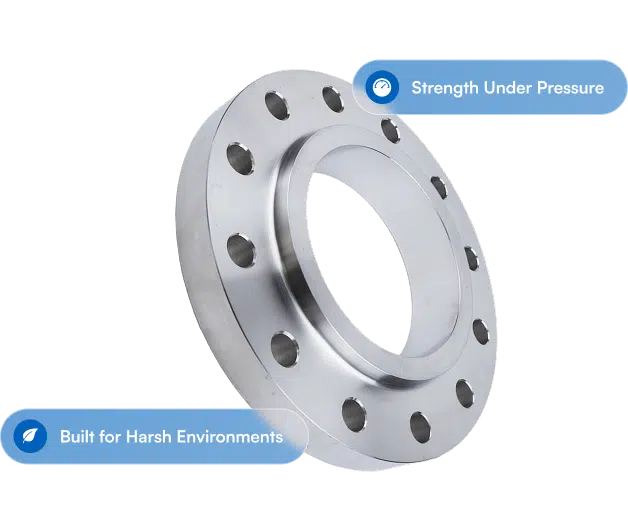
Flange Bolt Chart
Texas Flange has been providing ASME B16.5 flanges, and the bolting that goes with them, since 1986. This flange bolt chart lists bolt count, bolt diameter, and stud length for ASME B16.5 flanges, Class 150 through 2500, in both raised face and RTJ. Use it as a bolt size chart when specifying flange bolts, studs, and gaskets.
Filter by
Stud Bolt Size and Length Chart, Class 150 to 600
| 150 LB. Flanges | 300 LB. Flanges | 600 LB. Flanges | ||||||||||
|---|---|---|---|---|---|---|---|---|---|---|---|---|
| Nominal Pipe Size | # Bolts or Studs | Dia of Bolts or Studs | Length of Stud | # Bolts or Studs | Dia of Bolts or Studs | Length of Stud | # Bolts or Studs | Dia of Bolts or Studs | Length of Stud | |||
| 1/16 RF | RTJ | 1/16 RF | RTJ | 1/4 RF | RTJ | |||||||
| 1/2 | 4 | 0.50 | 2-1/4 | – | 4 | 0.50 | 2-1/2 | 3 | 4 | 0.50 | 3 | 3 |
| 3/4 | 4 | 0.50 | 2-1/2 | – | 4 | 0.63 | 3 | 3-1/2 | 4 | 0.63 | 3-1/2 | 3-1/2 |
| 1 | 4 | 0.50 | 2-1/2 | 3 | 4 | 0.63 | 3 | 3-1/2 | 4 | 0.63 | 3-1/2 | 3-1/2 |
| 1-1/4 | 4 | 0.50 | 2-3/4 | 3-1/4 | 4 | 0.63 | 3-1/4 | 3-3/4 | 4 | 0.63 | 3-3/4 | 3-3/4 |
| 1-1/2 | 4 | 0.50 | 2-3/4 | 3-1/4 | 4 | 0.75 | 3-1/2 | 4 | 4 | 0.75 | 4-1/4 | 4-1/4 |
| 2 | 4 | 0.63 | 3-1/4 | 3-3/4 | 8 | 0.63 | 3-1/2 | 4 | 8 | 0.63 | 4-1/4 | 4-1/4 |
| 2-1/2 | 4 | 0.63 | 3-1/2 | 4 | 8 | 0.75 | 4 | 4-1/2 | 8 | 0.75 | 4-3/4 | 4-3/4 |
| 3 | 4 | 0.63 | 3-1/2 | 4 | 8 | 0.75 | 4-1/4 | 4-3/4 | 8 | 0.75 | 5 | 5 |
| 3-1/2 | 8 | 0.63 | 3-1/2 | 4 | 8 | 0.75 | 4-1/4 | 5 | 8 | 0.88 | 5-1/2 | 5-1/2 |
| 4 | 8 | 0.63 | 3-1/2 | 4 | 8 | 0.75 | 4-1/2 | 5 | 8 | 0.88 | 5-3/4 | 5-3/4 |
| 5 | 8 | 0.75 | 3-3/4 | 4-1/4 | 8 | 0.75 | 4-3/4 | 5-1/4 | 8 | 1.00 | 6-1/2 | 6-1/2 |
| 6 | 8 | 0.75 | 4 | 4-1/2 | 12 | 0.75 | 4-3/4 | 5-1/2 | 12 | 1.00 | 6-3/4 | 6-3/4 |
| 8 | 8 | 0.75 | 4-1/4 | 4-3/4 | 12 | 0.88 | 5-1/2 | 6 | 12 | 1.13 | 7-1/2 | 7-3/4 |
| 10 | 12 | 0.88 | 4-1/2 | 5 | 16 | 1.00 | 6-1/4 | 6-3/4 | 16 | 1.25 | 8-1/2 | 8-1/2 |
| 12 | 12 | 0.88 | 4-3/4 | 5-1/4 | 16 | 1.13 | 6-3/4 | 7-1/4 | 20 | 1.25 | 8-3/4 | 8-3/4 |
| 14 | 12 | 1.00 | 5-1/4 | 5-3/4 | 20 | 1.13 | 7 | 7-1/2 | 20 | 1.38 | 9-1/4 | 9-1/4 |
| 16 | 16 | 1.00 | 5-1/4 | 5-3/4 | 20 | 1.25 | 7-1/2 | 8 | 20 | 1.50 | 10 | 10 |
| 18 | 16 | 1.13 | 5-3/4 | 6-1/4 | 24 | 1.25 | 7-3/4 | 8-1/4 | 20 | 1.63 | 10-3/4 | 10-3/4 |
| 20 | 20 | 1.13 | 6-1/4 | 6-3/4 | 24 | 1.25 | 8 | 8-3/4 | 24 | 1.63 | 11-1/4 | 11-1/2 |
| 24 | 20 | 1.25 | 6-3/4 | 7-1/4 | 24 | 1.50 | 9 | 10 | 24 | 1.88 | 13 | 13-1/4 |
How to Read a Stud Size From This Chart
Find your nominal pipe size in the left column, then read across to your pressure class. You get three things: how many studs, the stud diameter, and the stud length. Raised face and RTJ flanges have separate length columns, so use the one that matches your facing.
Example: a 4 inch Class 150 raised face flange takes 8 studs, 5/8 inch diameter, 3-1/2 inches long. The same flange with an RTJ face takes 4 inch long studs.
Diameters in the chart are in decimal inches. Here is the fraction for each one:
| Decimal | Fraction | Decimal | Fraction |
|---|---|---|---|
| 0.50 | 1/2 | 1.50 | 1-1/2 |
| 0.63 | 5/8 | 1.63 | 1-5/8 |
| 0.75 | 3/4 | 1.75 | 1-3/4 |
| 0.88 | 7/8 | 1.88 | 1-7/8 |
| 1.00 | 1 | 2.00 | 2 |
| 1.13 | 1-1/8 | 2.25 | 2-1/4 |
| 1.25 | 1-1/4 | 2.50 | 2-1/2 |
| 1.38 | 1-3/8 | 2.75 | 2-3/4 |
| 3.00 | 3 | ||
| 3.50 | 3-1/2 |
Need studs, nuts and gaskets to go with your flanges? We supply those too. Contact us with the size, class and facing.
Stud Bolt Size and Length Chart, Class 900 to 2500
| 900 LB. Flanges | 1500 LB. Flanges | 2500 LB. Flanges | ||||||||||
|---|---|---|---|---|---|---|---|---|---|---|---|---|
| Nominal Pipe Size | # Bolts or Studs | Dia of Bolts or Studs | Length of Stud | # Bolts or Studs | Dia of Bolts or Studs | Length of Stud | # Bolts or Studs | Dia of Bolts or Studs | Length of Stud | |||
| 1/4 RF | RTJ | 1/4 RF | RTJ | 1/4 RF | RTJ | |||||||
| 1/2 | 4 | 0.75 | 4-1/4 | 4-1/4 | 4 | 0.75 | 4-1/4 | 4-1/4 | 4 | 0.75 | 4-3/4 | 4-3/4 |
| 3/4 | 4 | 0.75 | 4-1/2 | 4-1/2 | 4 | 0.75 | 4-1/2 | 4-1/2 | 4 | 0.75 | 5 | 5 |
| 1 | 4 | 0.88 | 5 | 5 | 4 | 0.88 | 5 | 5 | 4 | 0.88 | 5-1/2 | 5-1/2 |
| 1-1/4 | 4 | 0.88 | 5 | 5 | 4 | 0.88 | 5 | 5 | 4 | 1.00 | 6 | 6 |
| 1-1/2 | 4 | 1.00 | 5-1/2 | 5-1/2 | 4 | 1.00 | 5-1/2 | 5-1/2 | 4 | 1.13 | 6-3/4 | 6-3/4 |
| 2 | 8 | 0.88 | 5-3/4 | 5-3/4 | 8 | 0.88 | 5-3/4 | 5-3/4 | 8 | 1.00 | 7 | 7 |
| 2-1/2 | 8 | 1.00 | 6-1/4 | 6-1/4 | 8 | 1.00 | 6-1/4 | 6-1/4 | 8 | 1.13 | 7-3/4 | 8 |
| 3 | 8 | 0.88 | 5-3/4 | 5-3/4 | 8 | 1.13 | 7 | 7 | 8 | 1.25 | 8-3/4 | 9 |
| 4 | 8 | 1.13 | 6-3/4 | 6-3/4 | 8 | 1.25 | 7-3/4 | 7-3/4 | 8 | 1.50 | 10 | 10-1/4 |
| 5 | 8 | 1.25 | 7-1/2 | 7-1/2 | 8 | 1.50 | 9-3/4 | 9-3/4 | 8 | 1.75 | 11-3/4 | 12-1/4 |
| 6 | 12 | 1.13 | 7-1/2 | 7-3/4 | 12 | 1.38 | 10-1/4 | 10-1/2 | 8 | 2.00 | 13-1/2 | 14 |
| 8 | 12 | 1.38 | 8-3/4 | 8-3/4 | 12 | 1.63 | 11-1/2 | 11-3/4 | 12 | 2.00 | 15 | 15-1/2 |
| 10 | 16 | 1.38 | 9-1/4 | 9-1/4 | 12 | 1.88 | 13-1/4 | 13-1/2 | 12 | 2.50 | 19-1/4 | 20 |
| 12 | 20 | 1.38 | 10 | 10 | 16 | 2.00 | 14-3/4 | 15-1/4 | 12 | 2.75 | 21-1/4 | 22 |
| 14 | 20 | 1.50 | 10-3/4 | 11 | 16 | 2.25 | 16 | 16-3/4 | – | – | – | – |
| 16 | 20 | 1.63 | 11-1/4 | 11-1/2 | 16 | 2.50 | 17-1/2 | 18-1/2 | – | – | – | – |
| 18 | 20 | 1.88 | 12-3/4 | 13-1/4 | 16 | 2.75 | 19-1/2 | 20-3/4 | – | – | – | – |
| 20 | 20 | 2.00 | 13-3/4 | 14-1/4 | 16 | 3.00 | 21-1/4 | 22-1/4 | – | – | – | – |
| 24 | 20 | 2.50 | 17-1/4 | 18 | 16 | 3.50 | 24-1/4 | 25-1/2 | – | – | – | – |

Flange Bolt Torque Pattern by Bolt Count
Once you know how many studs your flange takes from the chart above, tighten them in this order. Number the bolts 1 through the total, going clockwise, starting at any bolt. Then follow the sequence on every pass. Each step crosses the flange, so the gasket gets pulled down evenly instead of pinched on one side. This is the legacy cross pattern that ASME PCC-1 lists as an acceptable option.
| Bolts | Tighten in this order |
|---|---|
| 4 | 1, 3, 2, 4 |
| 8 | 1, 5, 3, 7, 2, 6, 4, 8 |
| 12 | 1, 7, 4, 10, 2, 8, 5, 11, 3, 9, 6, 12 |
| 16 | 1, 9, 5, 13, 3, 11, 7, 15, 2, 10, 6, 14, 4, 12, 8, 16 |
| 20 | 1, 11, 6, 16, 3, 13, 8, 18, 5, 15, 10, 20, 2, 12, 7, 17, 4, 14, 9, 19 |
| 24 | 1, 13, 7, 19, 4, 16, 10, 22, 2, 14, 8, 20, 5, 17, 11, 23, 3, 15, 9, 21, 6, 18, 12, 24 |
Torque values by stud size and class, and the multi-pass method, are on our flange bolt torque guide.
Is there an 18 bolt torque pattern?
Not for an ASME B16.5 flange. Every bolt count in the chart above is a multiple of four, from 4 to 24. If you are looking for an 18 bolt pattern, check whether you actually have an 18 inch flange. An 18 inch B16.5 flange takes 16 bolts in Class 150, 24 in Class 300, 20 in Class 600 and Class 900, and 16 in Class 1500. Use that row in the table above. For a flange with a bolt count that is not on this list, follow the flange or equipment maker's assembly procedure.
Frequently Asked Questions
- How many bolts does a flange have?
- ASME B16.5 flanges always have a bolt count that is a multiple of four, from 4 bolts on small sizes to 20 or more on large diameters. The exact count, bolt size, and bolt circle depend on the nominal size and pressure class; use the chart above to look up yours.
- What is the difference between a stud bolt and a machine bolt?
- A stud bolt is a fully threaded rod tightened with two heavy hex nuts, and is standard for most flange connections, especially higher-pressure and critical service. A machine bolt has a fixed hex head and a single nut, and is used mainly in lower-pressure, non-critical applications.
- What material are flange bolts made from?
- The most common combination for carbon and alloy steel flanges is ASTM A193 Grade B7 stud bolts with ASTM A194 Grade 2H heavy hex nuts. Stainless and special-service applications use grades such as B8 or B8M. We can supply bolting to match your flange and service.
- What length stud bolt do I need for a flange?
- Stud length is driven by the combined thickness of the two flanges, the gasket, and the facing, plus enough thread to engage both nuts. The chart above lists standard stud lengths by size and class; tell us your gasket and facing and we will confirm.
- What bolt size does a Class 150 flange use?
- Class 150 bolt diameters run from 1/2" on small sizes up to 1-1/4" on a 24" flange. The chart above gives the exact diameter, count, and bolt circle for every size.
- What is the correct bolt torque for a flange?
- Flange bolt torque depends on bolt diameter, bolt material, gasket type, and the target bolt stress, so there is no single value per flange size. Torque is calculated for the joint rather than read from the flange class alone. ASME PCC-1 is the standard that covers bolted flange joint assembly, including how assembly torque is determined and the tightening sequence to use. Start with this bolt chart to confirm bolt count, diameter and stud length, since those are the inputs any torque calculation needs, then see our flange bolt torque values reference for worked figures by pressure class. For torque on a specific gasket and bolt grade, follow the bolting or gasket manufacturer's published procedure.
- What is the bolt circle diameter on an ASME B16.5 flange?
- The bolt circle diameter is the diameter of the imaginary circle passing through the centers of the bolt holes. It is fixed by nominal pipe size and pressure class under ASME B16.5, and it is what determines whether two flanges will mate. This chart covers bolt count, bolt diameter and stud length; for bolt circle diameter by size, see the ASME B16.5 dimension tables class by class, starting with the Class 150 dimension table.
- Do Class 150 and Class 300 flanges use the same bolts?
- No. Class 300 flanges use a larger bolt circle than Class 150 at every size, and in most sizes larger diameter bolts, a higher bolt count, or both. At 1/2" and 5" the bolt count and diameter are the same, but the bolt circles still differ. A Class 150 and a Class 300 flange of the same nominal pipe size will not bolt together. Check the bolt count and diameter in the chart on this page, and the bolt circle in the Class 150 and Class 300 dimension tables, before ordering.
- What size studs does a 4 inch Class 150 flange use?
- A 4 inch Class 150 flange uses 8 studs, 5/8 inch diameter. Stud length is 3-1/2 inches for a raised face flange and 4 inches for RTJ. The chart above lists every size from 1/2 inch through 24 inch.
- Are RTJ studs longer than raised face studs?
- Often. On this chart the RTJ stud is longer than the raised face stud in 64 of the 110 size and class combinations that list both, and the same length in the other 46. It is never shorter. Use the RTJ column for ring type joint flanges.